How to Read Pantry Food Labels for the Dish You’re Making
Read pantry food labels to spot ingredients, serving details, and preparation directions that fit your recipe, then choose without treating a label as a score.
Pantry food labels can tell you whether a product fits tonight’s recipe before you open it. Start with the package’s contents and directions, then use the Nutrition Facts panel only for details that matter to your cooking or dietary needs.
A label is a description, not a ranking. Read each part for the question it can answer: what is in the package, how the product is intended to be used, and what information may affect your choice.
Begin with the package’s identity and directions
Read the product name and any description on the front, then turn to the preparation directions. Words such as “seasoned,” “concentrate,” “ready to serve,” or “for baking” can distinguish products that otherwise look similar on a shelf.
Directions may tell you to drain, dilute, cook, or add another ingredient. Treat serving suggestions as clues rather than rules, and check the recipe to see whether the product’s intended use matches your plan.
Use ingredient order to understand the recipe’s contents
Ingredients are generally listed in descending order by weight. The first items therefore tell you more about the product’s composition than the later ones, but their order does not determine whether the product suits your meal.
Suppose you are choosing canned beans for a salad. One label lists beans, water, and salt; another lists beans, water, salt, and a seasoning blend. If you want to season the salad yourself, the plainer list may give you more control; if the blend suits the dish, the seasoned version may save a preparation step.
Compare products with similar purposes. A plain sauce and a seasoned sauce are not exact substitutes, so a longer ingredient list is not automatically a reason to reject one. Check whether an added oil, sweetener, thickener, or seasoning matters to your recipe or personal requirements.
Read Nutrition Facts for a specific comparison
The ingredient list describes what is in the product; the Nutrition Facts panel reports selected nutrients for a stated serving. Check the serving description before comparing two panels, since their serving amounts may differ.
Choose a nutrient to compare only when it bears on the dish or your needs. For example, sodium may matter when two broths are going into the same soup; it may be less relevant to a condiment used in a small amount for flavor.
If a medical condition or dietary requirement affects what you can eat, treat package information as general guidance and ask a qualified health professional for advice specific to you.
Read the form and handling notes carefully
A product’s form may tell you what preparation it needs, not whether it is better. Canned, dried, frozen, powdered, jarred, and refrigerated foods can differ in moisture, texture, and concentration.
Check whether the contents are whole, sliced, crushed, pureed, or concentrated. Then look for directions about soaking, cooking, draining, or dilution. A concentrated product is not the same amount of ready-to-use food, and a frozen ingredient may release moisture as it warms.
Keep storage and preparation directions tied to the specific package. Similar-looking products can have different instructions, so follow the information provided for the one you choose.
What should you compare on pantry food labels?
Does the first ingredient decide which package to buy?
No. Ingredient order helps explain composition, but the product’s form, full ingredient list, directions, and your recipe all affect whether it fits.
Is a shorter ingredient list always preferable?
No. A short list may suit a plain ingredient, while a longer one may describe a seasoned product. Decide whether the listed additions work for your dish and personal requirements.
How should you compare packages with different serving amounts?
Read the serving descriptions and the package contents, then consider how much your recipe calls for. If the serving amounts differ, avoid treating the nutrient figures as a direct comparison without accounting for that difference.
What can you do when a label is unclear?
Check the product name, ingredient list, and preparation directions against the recipe. If a dietary detail or intended use remains uncertain, choose a clearly labeled alternative or seek reliable guidance from the manufacturer or a qualified professional where relevant.
Make the choice by recording what the label tells you
For a quick decision, check these details and let each result guide the next action:
- Check the product name; if it matches the ingredient your recipe calls for, compare its directions, but if it names a different product, set it aside or find a closer match.
- Check whether the recipe needs a plain or seasoned product; if the label shows the right type, continue comparing, but if it shows an unwanted seasoning, choose a plain alternative.
- Check the ingredient list for an addition that matters to your recipe or personal needs; if the list fits, keep the package in consideration, but if it does not, choose another product and review its list.
- Check the form, such as whole, crushed, dried, or concentrated; if it matches the recipe’s needs, proceed, but if it does not, choose the required form or confirm that the recipe can accommodate the difference.
- Check the preparation directions; if they fit the time and method you have, use the product as directed, but if they require an unsuitable step, select a product with workable directions.
- Check the serving description before comparing a nutrient; if the servings align and the nutrient matters to your dish, compare the panels, but if they do not align, account for the difference or leave that comparison out.
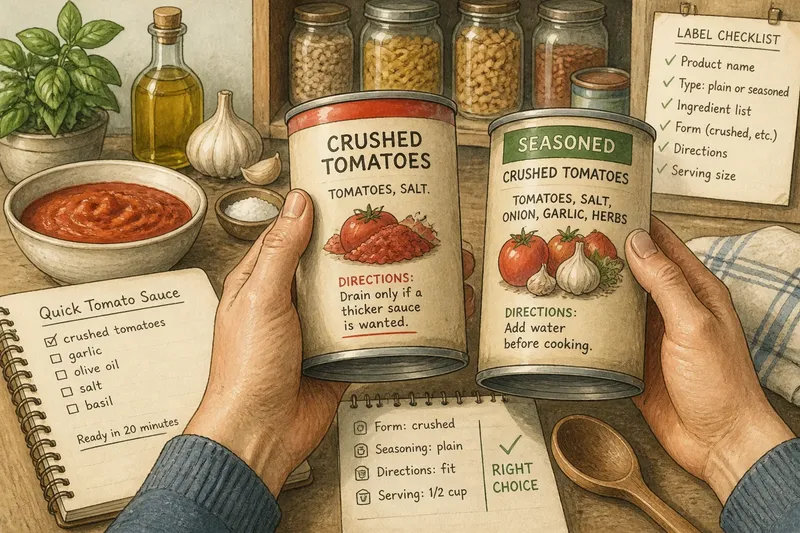
Imagine you have a recipe for a quick tomato sauce that calls for crushed tomatoes, and you have two labeled cans in front of you. The first lists tomatoes and salt and says to drain only if a thicker sauce is wanted; the second is seasoned and directs you to add water. You check that the first can’s form matches the recipe, decide its salt fits your meal, and choose it because its directions fit the sauce you plan to make. The second can could still suit another recipe, but its extra seasoning and water instruction do not match this one as directly.
When comparing pantry food labels, describe the decision in concrete terms: the product is crushed rather than whole, includes seasoning, or needs dilution. That keeps the choice tied to the recipe and the information on the package instead of turning a label into a verdict on the food.