The Authentic Recipe Test Misses the Point
The authentic recipe test can flatten a living dish into a rulebook. Learn how to describe a recipe’s lineage, purpose, and variations with care.
The authentic recipe test can turn a dish into a pass-or-fail exercise: one version is declared correct, and every other one is treated as a mistake. Yet a recipe can carry distinct meanings in a family kitchen, a restaurant, or a holiday meal. To discuss it fairly, name the version and the people or setting it belongs to.
That approach does not mean every preparation is interchangeable. It distinguishes a specific tradition from a claim that one recipe represents everyone, and it gives cooks a way to describe adaptations without pretending they reproduce an older version exactly.
The authentic recipe test confuses one account with a universal rule
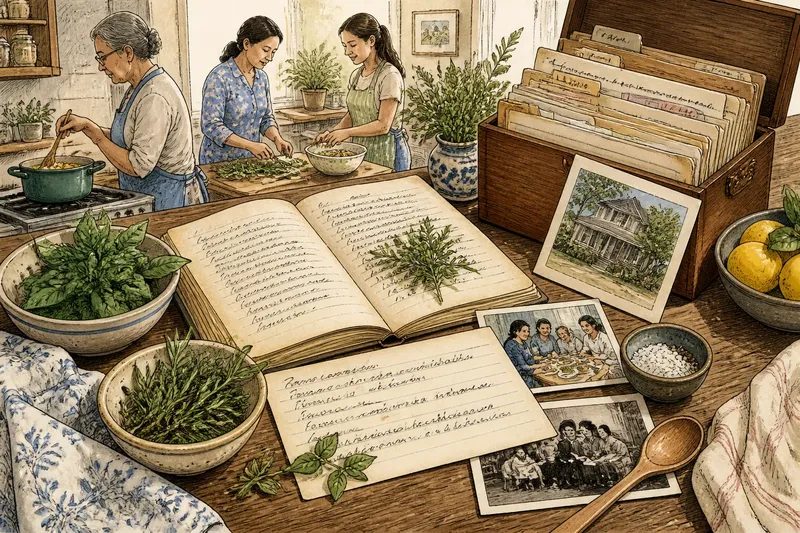
Written recipes make cooking easier to repeat, but they do not always show how a cook learned the dish or what the instructions leave unsaid. Someone may rely on a familiar aroma, a softening texture, or a sequence learned by watching a relative. A neatly formatted recipe can make those choices invisible.
When one version circulates widely, its ingredients and method may be mistaken for the only legitimate form. The more precise question is: whose customary preparation does this recipe describe? “My grandmother’s Sunday version” makes a narrower, more useful claim than “the authentic version.”
The word “authentic” can refer to a family’s customary method, a community practice, a particular technique, or a cook’s connection to a dish. Those meanings are not interchangeable. Naming the specific claim helps readers understand what is being preserved and what may vary.
Family memory gives a recipe meaning beyond its ingredient list
A dish can matter because it marks a gathering, recalls a relative, or signals that a particular occasion has begun. Those meanings do not require every household to cook it the same way. They do require care when someone describes a family version as if it spoke for a larger community.
Imagine a family whose written recipe calls for a particular herb. A younger relative, remembering that the dish was always served at reunions, makes it with a different herb after learning the recipe from an aunt who used that version. The resulting flavor changes, but the family can describe the dish as its reunion preparation rather than claim that the two herb choices are identical or universally traditional.
When relatives disagree about a recipe, ask what each person remembers: who usually cooked it, when it appeared, and which details felt essential. Their answers may reveal that they are describing different branches of a family’s practice, not one person’s error.
Describe recipe variations by what changed and what stayed
A useful account separates observable changes from claims about identity. An ingredient swap can affect bitterness, aroma, moisture, or texture; it does not automatically erase a dish’s history, nor does it leave the result unchanged. Explain the difference instead of asking a single word to settle the question.
Before adapting a recipe, identify the ingredient’s job. Does it add acidity, richness, crunch, or fragrance? Then consider what the replacement contributes and what adjustment follows. A substitute that brings its own salt, for example, may call for less added salt; describe that as a cooking adjustment, not as proof that the dish tastes the same.
- Check whether the recipe names a family, community, or place; if it does, retain that context, and if it does not, avoid presenting the version as representative of a whole group.
- Check whether an ingredient has been replaced; if the replacement changes flavor or texture, name it and describe the difference, and if it does not, still avoid claiming the versions are identical without a basis.
- Check whether the method comes from a written recipe or remembered practice; if it is remembered, say so, and if the source is uncertain, describe it as an account rather than settled history.
- Check whether a dish is tied to an occasion; if it is, mention the occasion, and if it is not, do not invent a ritual or customary role.
- Check whether several relatives describe the preparation differently; if they do, record the versions separately, and if they agree, attribute the account to those relatives rather than to every household.
- Check whether the word “traditional” has a clear referent; if it names a specific family or community practice, use it with that context, and if it does not, choose a more precise description such as “my adapted version.”
How should you talk about a recipe’s authenticity?
Can a dish have more than one authentic version?
Yes. Different families or communities may sustain distinct customary preparations, so name the household, place, or tradition you mean rather than implying that one recipe speaks for everyone.
Does changing an ingredient make a recipe inauthentic?
Not automatically, but a change can alter flavor, texture, or significance. State what changed and avoid presenting the adapted result as identical to the version that inspired it.
How can you tell whether a recipe represents a community?
Look for a specific account of who makes it, where it is customary, and whether the writer acknowledges variation. One recipe page alone is not a basis for speaking on behalf of every household.
When is it appropriate to call a recipe traditional?
Use “traditional” when you can identify the practice it refers to, such as a family’s established preparation or a customary version in a particular community. If the recipe is adapted, name the adaptation too.
Share a recipe with its lineage and limits
When publishing or passing along a dish, include the details that clarify its scope: who taught it, the setting where it is served, and any change you made. If you do not know its history, say what you do know instead of filling the gap with a broad claim.
Say you have a handwritten recipe from an aunt that lists one herb, while your family recalls her using another at holiday dinners. You can note both inputs—the written ingredient and the relatives’ memory—then describe the version you choose to cook and label it accordingly. The resulting account preserves the disagreement as part of the record rather than resolving it with an unsupported claim.
The authentic recipe test misses the point when it treats every variation as a verdict on who belongs or who cooks correctly. A more useful description identifies the recipe’s lineage, states what has changed, and leaves room for other people to name their own versions.