The Long Journey of the Tomato Through Kitchens
Trace the tomato’s journey from the Americas into kitchens abroad and see how fresh eating, cooking, and preserving gave it distinct local roles.
The tomato’s journey from the Americas into kitchens abroad unfolded through gardens, markets, and household cooking—not through one uniform moment of acceptance. Indigenous communities in the Americas cultivated and ate tomatoes before Spanish colonial exchange carried the plant across the Atlantic, where its uses developed unevenly across regions.
Tomato cultivation began in the Americas
Tomatoes have American origins, and Indigenous communities cultivated and ate them before Europeans encountered the plant. The fruit was not a single uniform type: tomatoes vary in color, size, texture, and flavor.
Spanish colonial exchange brought tomato plants and seeds from the Americas to Europe and other parts of the world. The broad route is clear, but the details of adoption differed from place to place. A seed reaching a port or garden did not by itself establish the tomato as a routine food; cultivation, local growing conditions, and decisions about how to cook it all mattered.
In Europe, tomatoes were grown in some settings as ornamental plants before they became familiar foods. Their botanical kinship with poisonous plants may have contributed to caution, but that explanation alone cannot account for varied regional responses. It is safer to describe acceptance as uneven than to imply one shared European reaction.
Growing conditions and kitchen habits shaped adoption
Once tomatoes reached a new region, local growing conditions influenced whether people could raise them reliably. Kitchen habits shaped their use: cooks could slice ripe fruit, add it to a cooked dish, or preserve a harvest for later. These options did not create one universal sequence of adoption.
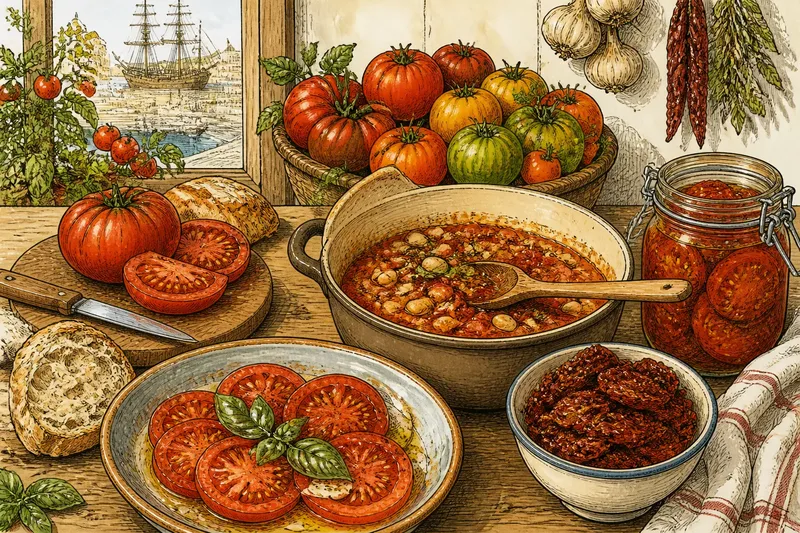
In parts of the Mediterranean, tomatoes became useful both fresh and cooked. A ripe fruit could accompany bread or other foods, while a larger harvest could be cooked down or preserved. Elsewhere, tomatoes may have entered meals through home gardens or particular local preparations. Such descriptions are regional patterns, not claims that every household followed the same path.
A dish now associated with a place may have taken shape through repeated local choices rather than arriving as a finished tradition alongside the plant. Existing ingredients and cooking methods offered ways to make tomatoes useful; repeated use could, in time, make a pairing familiar.
Fresh, cooked, and preserved tomatoes do different work
Fresh tomatoes contribute juiciness and a sharp, sometimes sweet flavor. Cooking softens the fruit and concentrates its taste as moisture evaporates. Dried tomatoes offer a more concentrated flavor and can be stored for later use.
Those differences suit distinct kitchen tasks. A sliced tomato can brighten bread, beans, or greens; a cooked tomato can help bring the ingredients in a pot together. Preservation, including drying and canning, extends use beyond the fresh harvest, though practices and preserved foods vary by place.
Imagine a household with ripe tomatoes and dried beans set aside for supper. The cook slices one tomato to serve with bread, then simmers the remaining fruit with the beans; the expected result is a fresh, juicy side and a softer, blended flavor in the pot. This invented situation shows how one ingredient can serve two purposes without requiring a new dish or a single standard recipe.
How did tomatoes become familiar in different kitchens?
Did Europeans immediately eat tomatoes?
No. Tomatoes were grown in some European settings as ornamental plants before becoming familiar foods, and adoption varied by region and household. Growing conditions, beliefs, and cooking habits all shaped their reception.
What made tomatoes adaptable to different meals?
They could be eaten fresh, cooked with other ingredients, or preserved for later. Cooks could fit those forms into meals and methods already familiar to them.
Did tomatoes create the dishes now associated with them?
Not on their own. Cooks combined tomatoes with existing ingredients and techniques, and repeated choices could develop into local traditions. A dish’s history may include practices that predate the tomato’s arrival.
Why do tomato traditions differ by region?
Growing conditions, harvest timing, preservation practices, staple foods, and household preferences vary. Those differences shape whether tomatoes are served fresh, cooked into a dish, or kept for later.
Local combinations gave tomatoes social meaning
Tomatoes entered kitchens organized around existing staples. They could become a sauce for pasta, a companion to bread, or an ingredient alongside beans, rice, fish, meat, or vegetables. These examples describe possibilities, not a single history shared by every community.
Over time, repeated food habits can give an ingredient associations beyond taste. A pot of cooked tomatoes may call to mind a household’s seasonal routine; preserved fruit may recall the work of setting food aside. The meanings depend on the people and occasions involved, rather than on the tomato alone.
Migration and trade carried seeds, recipes, and preferences into new kitchens. There, different ingredients or equipment could lead cooks to alter a familiar preparation while keeping some of its earlier character.
Kitchen choices make the tomato’s history visible
To follow the tomato’s history, look at what cooks do with it: whether they serve it fresh, simmer it into a meal, or preserve it for another season. The form of the fruit and its role in a dish offer concrete clues to how it fits local food habits.
At a market, for example, a shopper might choose firm tomatoes for slicing and softer fruit for cooking. That ordinary distinction connects a harvest to the practical work of preparing a meal.
The tomato’s history becomes most specific at the table: notice what accompanies it, how it was prepared, and whether it is fresh or stored. Those details can distinguish a household’s seasonal habit from a broader regional tradition, without treating either as the single story of the fruit.